

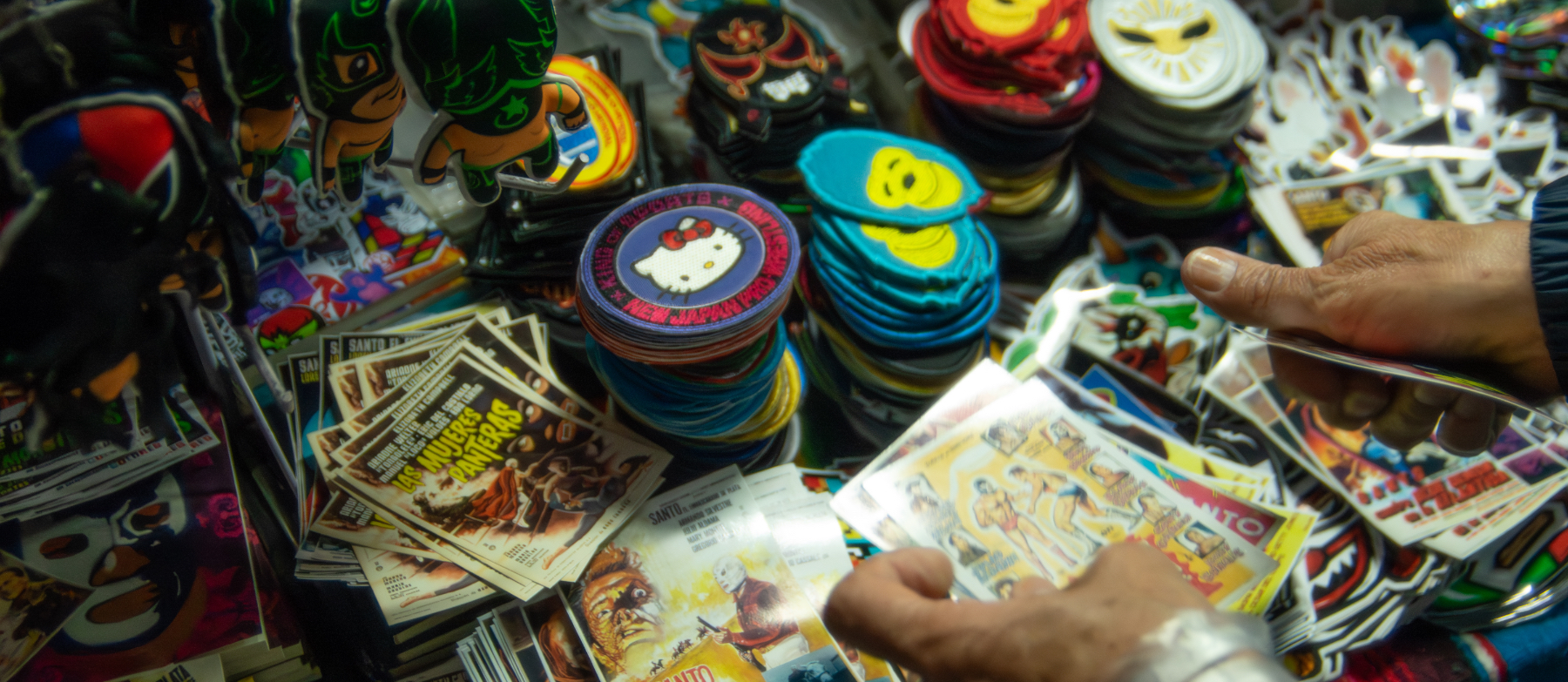
Outside the Arena México, a stand like no other
On lucha libre nights in Mexico City, the excitement starts well before the first fight. Outside the Arena México, between mask vendors and taco stands, one stall catches the eye of aficionados: the one belonging to Dr. Rabias. Brightly coloured Mexican wrestler stickers, keyrings featuring Pentágon, screen-printed Mr. Niebla t-shirts — each piece is made by a single man.
For over a decade, Dr. Rabias has become a key figure in the world of Mexican lucha libre, not in the ring, but right next to it: where Mexican wrestling culture becomes art.
From political journalism to street art
Behind the Dr. Rabias persona is Edgar Vargas Reyes, a graduate in communications from UNAM and in film animation from UCLA. Before drawing luchadores, he covered Mexican politics for La Jornada and El Nacional.
In 2000, tired of journalism, he turned to illustration for tattoo, rock and skateboard magazines. Then came the turning point: street art. With his project Ataque Ninja, he covered the walls of Mexico City with stencils and stickers populated by aliens, gunmen and — already — masked luchadores.
His daughter Edén, whom he nicknames La Princesa Ninja, grew up surrounded by spray cans and stencils. Street art naturally led Dr. Rabias to the world that would become his permanent playground: lucha libre.
200 luchadores, one illustrator
It all started when two wrestlers asked him to design their characters for t-shirts. Then four. Then twenty. Today, Dr. Rabias has created merchandise for nearly 200 luchadores, from legends like Pagano and Pentágon to popular figures such as Súper Pinocho and Kemuñeco Súper Ratón.
His method: “blending the character with their vivencias” — diving into each wrestler’s story and personality to create illustrations that are not mere portraits, but distilled identities. T-shirts, stickers, keyrings, collectible figures: each item tells something about the luchador it represents.
His stand outside the Arena México has become a ritual for lucha libre fans. People come as much for the art as for the wrestling.
The mask, far beyond the ring
What Dr. Rabias’s work highlights is that lucha libre goes far beyond sport. The luchador mask is a cultural object in its own right: a symbol of identity, mystery, and popular pride. The greats — El Santo, Blue Demon, Rey Mysterio — transcended the ring to become icons of Mexico, on a par with Frida Kahlo or the calaveras of Día de Muertos.
That’s where our lucha libre masks and collectibles come from — from Dr. Rabias’s stand and his neighbours, right outside the Arenas on fight nights. A direct dive into the authentic world of Lucha Libre in Mexico City.
A legend in progress
Nobody really knows whether Dr. Rabias was once a real Mexican wrestler or not. Depending on the night and who you ask, he stepped into the ring and retired for personal reasons, or because of an injury, or because of… well, nobody actually knows. According to others, Dr. Rabias was never a real Mexican wrestler but owes his reputation to his many collaborations with the professional lucha libre world.
In truth, only he and his wife know. It doesn’t matter. Far from the small street stand nestled among the others where they welcome their customers, the legend of Dr. Rabias is being built and spreading. That legend is the truth!
